
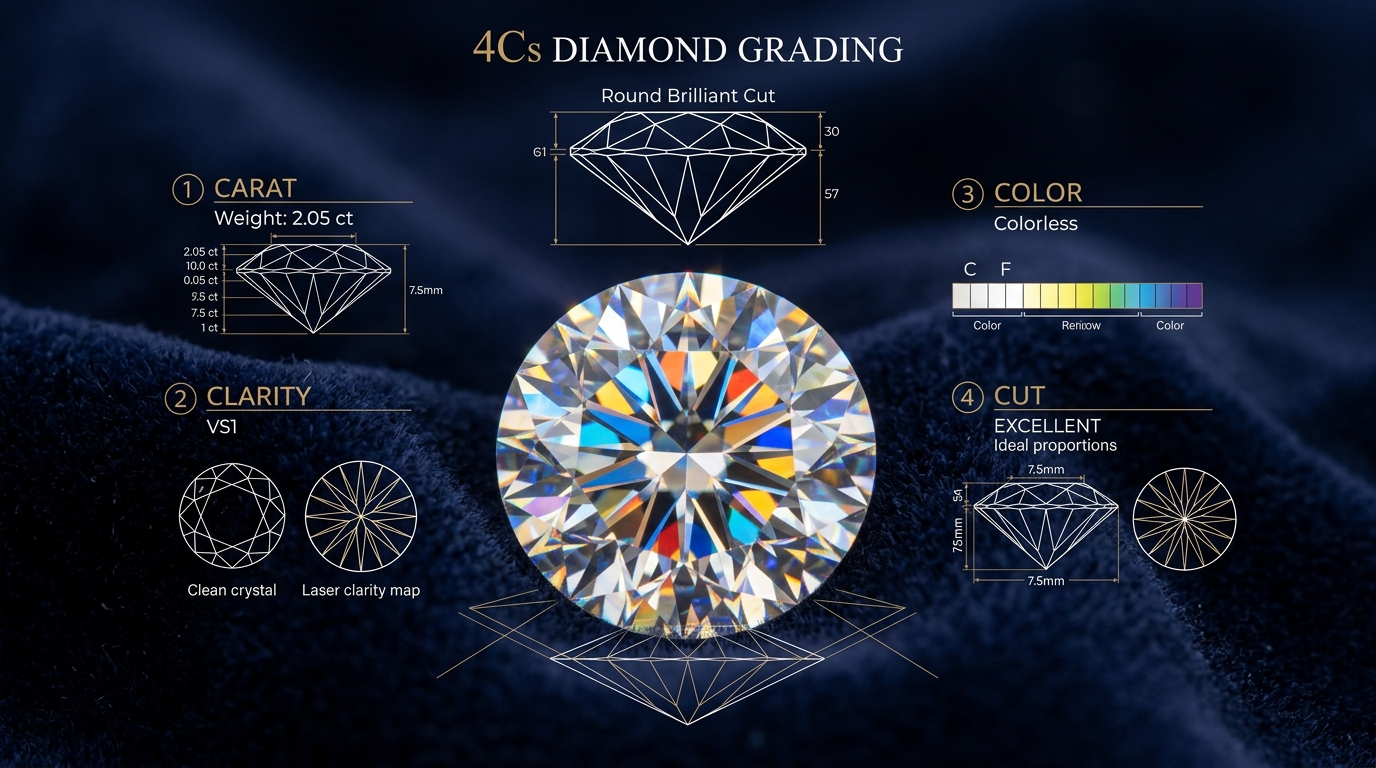
Diamond Grading
Understanding the 4Cs of Diamond Quality: Cut, Color, Clarity & Carat
Explore the universal standard established for evaluating diamond quality. Learn how each 'C' influences beauty, optical performance, and value.
Global Diamond Laboratory
ISO & International Gemological Accreditation • Mon – Fri: 10:00 – 19:00
Understand the chemical identity, crystal growth patterns (HPHT vs. CVD), and spectroscopic methods used by gemologists to distinguish natural and created stones.
Sophia Chen, FGA
Spectroscopy Specialist & Research Director
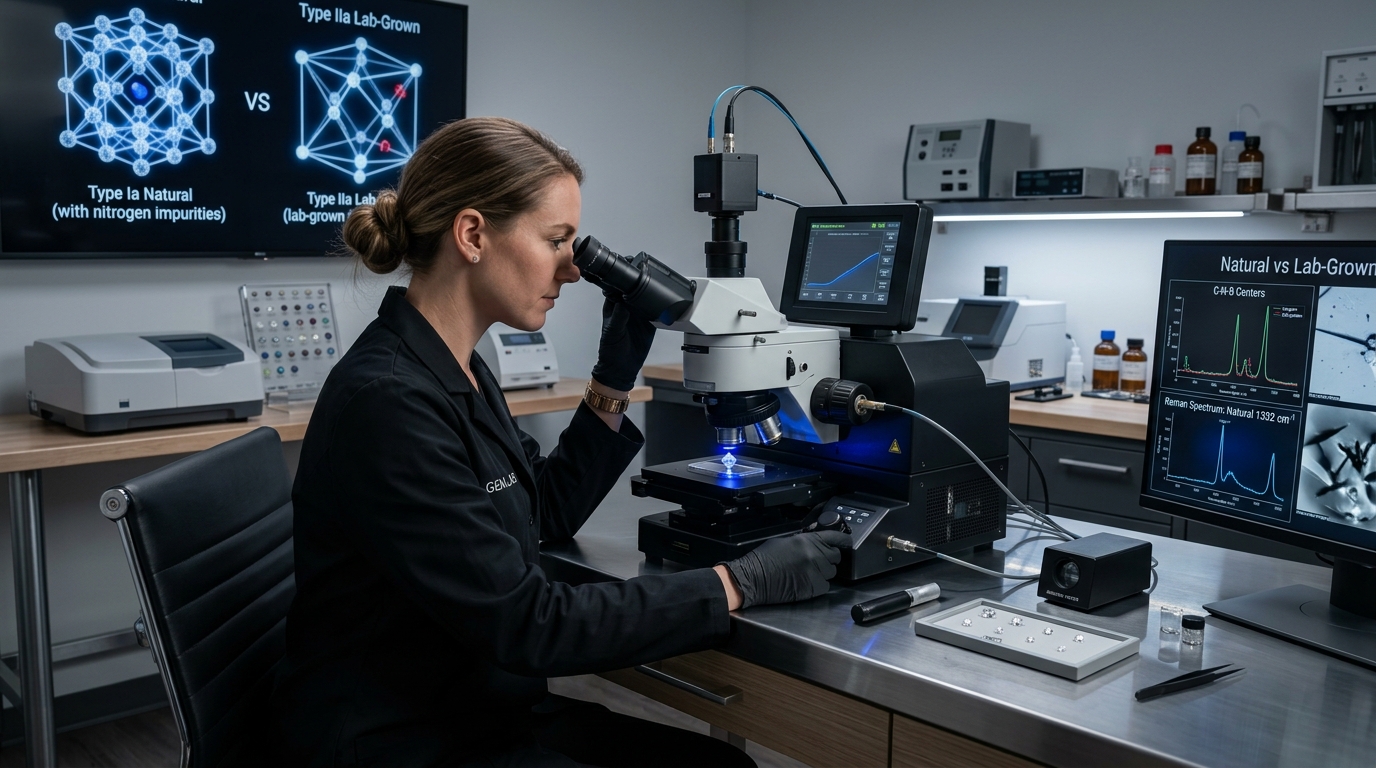
Gemological microscope analyzing natural vs lab grown diamond crystal lattice
Laboratory-grown diamonds (LGDs) have become a major presence in today's fine jewellery industry. Because both natural and lab-created diamonds are composed of pure crystallized carbon in an isometric lattice, they exhibit identical refractive index (2.417), hardness (10 on Mohs scale), and thermal conductivity.
Standard handheld thermal diamond testers cannot distinguish between them. Determining whether a stone was formed over billions of years in the Earth's mantle or synthesized in a laboratory reactor requires advanced gemological laboratory equipment.
There are two primary methods used to create gem-quality diamonds in laboratories:
Professional gemological institutes like GGDL employ multi-tiered testing protocols to deliver 100% conclusive identification:
1. Fourier-Transform Infrared Spectroscopy (FTIR): Determines diamond type (Type Ia, Ib, IIa, IIb). Over 98% of natural diamonds are Type Ia (containing aggregated nitrogen), whereas most lab-grown diamonds are Type IIa (near-zero nitrogen).
2. Deep UV Luminescence Imaging: Analyzes growth morphology. Natural diamonds show octahedral growth sectors, HPHT stones exhibit geometric cross patterns, and CVD stones reveal planar dislocation striations.
3. Photoluminescence (PL) Spectroscopy at Cryogenic Temperatures: Detects atomic-level lattice defects, silicon-vacancy centers (SiV-), and catalyst metal trace residues (like nickel or iron).
“Every diamond certified at GGDL undergoes rigorous automated and spectroscopic screening to guarantee origin disclosure on every grading report.”
No. Because the optical properties and inclusions are identical, only specialized laboratory spectrometers and UV luminescence instruments can provide definitive origin verification.
Yes, chemically, physically, and optically they are pure crystallized carbon diamonds; the only difference is their origin and growth timeline.
Spectroscopy Specialist & Research Director
Dedicated to unbiased gemological examination, spectroscopic research, and consumer education at GGDL Laboratory.
Explore the universal standard established for evaluating diamond quality. Learn how each 'C' influences beauty, optical performance, and value.
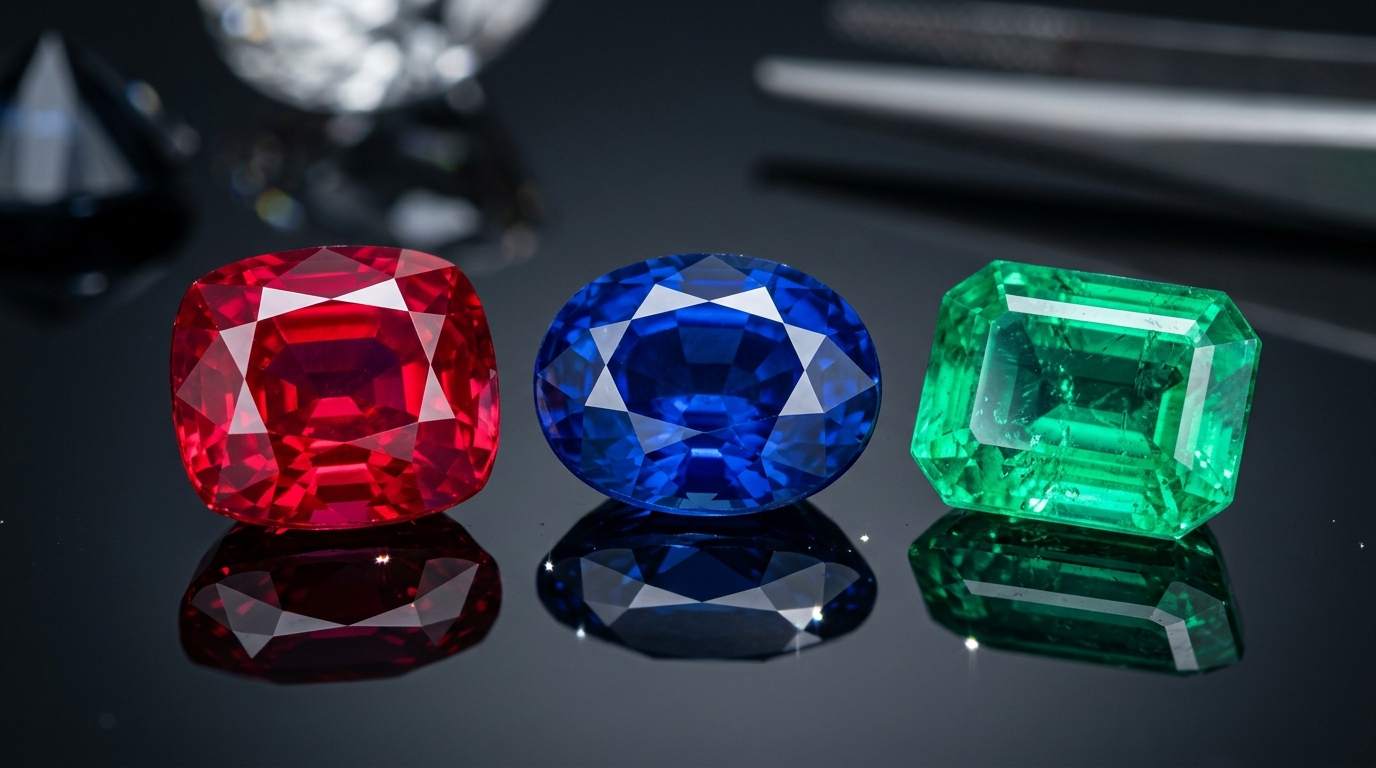
A comprehensive guide to identifying the Big Three precious gemstones, recognizing common heat and clarity treatments, and understanding geographic origin determinations.

Keep your heirloom jewellery sparkling for generations. Expert tips on safe at-home cleaning, ultrasonic cleaner hazards, and storage best practices.